

The force-frequency relationship (FFR) or positive ‘Treppe’ is a fundamental property of myocardium that is particularly important to the adaptive response to stress. It has been estimated, for example, that at least 40% of the increase in cardiac output seen during exercise can be attributed to the effect of the FFR (Fig).
Both the force-rate trajectory and the ‘optimal’ heart rate (that heart rate associated with maximal force development, beyond which contractility falls) reflect myocyte function and global myocardial contractile behaviour. Intact intracellular calcium (Ca2+) cycling is a fundamental requirement for myocyte shortening. Studies using inhibitors of SERCA2a such as cyclopiazonic acid and thapsigargin, and blockade of the SR Ca2+ release channel with ryanodine have shown significant effects on the FFR. It follows that changes in phospholamban activity will influence the FFR.
Abnormal intracellular calcium handling is thought to be the major cause of human myocardial contractile dysfunction. Intracellular Ca2+ transients correlate well with contractile function, and myocytes from failing hearts have both significantly decreased SERCA2a activity, and enhanced expression of the sarcolemmal sodium/calcium exchanger. This is manifest clinically as a blunted FFR in patients with heart failure. There are few data available in congenital heart disease.
Our ability to examine force frequency relations clinically would be greatly enhanced by a non-invasive index of contractility which was sensitive enough to describe such relationships, but robust in terms of load dependency.
In this presentation I will present a novel method, derived by Tissue Doppler, which has the potential to allow such evaluations. The experimental background, first clinical data, and potential applications will be discussed.
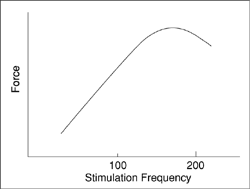
Schematic plot showing the normal myocardial force-
frequency relationship. Contractile force is maximal at a
stimulation frequency of 190 beats per minute
frequency relationship. Contractile force is maximal at a
stimulation frequency of 190 beats per minute